

Warning: Undefined array key "HTTP_CLOUDFRONT_FORWARDED_PROTO" in /var/www/public/www.enago.com/academy/wp-config.php on line 10

Notice: Function _load_textdomain_just_in_time was called incorrectly. Translation loading for the accelerated-mobile-pages domain was triggered too early. This is usually an indicator for some code in the plugin or theme running too early. Translations should be loaded at the init action or later. Please see Debugging in WordPress for more information. (This message was added in version 6.7.0.) in /var/www/public/www.enago.com/academy/wp-includes/functions.php on line 6121

Notice: Function _load_textdomain_just_in_time was called incorrectly. Translation loading for the cite domain was triggered too early. This is usually an indicator for some code in the plugin or theme running too early. Translations should be loaded at the init action or later. Please see Debugging in WordPress for more information. (This message was added in version 6.7.0.) in /var/www/public/www.enago.com/academy/wp-includes/functions.php on line 6121

Notice: Function _load_textdomain_just_in_time was called incorrectly. Translation loading for the favorites domain was triggered too early. This is usually an indicator for some code in the plugin or theme running too early. Translations should be loaded at the init action or later. Please see Debugging in WordPress for more information. (This message was added in version 6.7.0.) in /var/www/public/www.enago.com/academy/wp-includes/functions.php on line 6121

Notice: Function _load_textdomain_just_in_time was called incorrectly. Translation loading for the miniorange-login-openid domain was triggered too early. This is usually an indicator for some code in the plugin or theme running too early. Translations should be loaded at the init action or later. Please see Debugging in WordPress for more information. (This message was added in version 6.7.0.) in /var/www/public/www.enago.com/academy/wp-includes/functions.php on line 6121

Deprecated: TotalPollVendors\TotalCore\Foundation\Environment implements the Serializable interface, which is deprecated. Implement __serialize() and __unserialize() instead (or in addition, if support for old PHP versions is necessary) in /var/www/public/www.enago.com/academy/wp-content/plugins/totalpoll/vendor/misqtech/totalsuite-totalcore/src/Foundation/Environment.php on line 14

Notice: Function _load_textdomain_just_in_time was called incorrectly. Translation loading for the user-profile domain was triggered too early. This is usually an indicator for some code in the plugin or theme running too early. Translations should be loaded at the init action or later. Please see Debugging in WordPress for more information. (This message was added in version 6.7.0.) in /var/www/public/www.enago.com/academy/wp-includes/functions.php on line 6121

Notice: Function _load_textdomain_just_in_time was called incorrectly. Translation loading for the wp-latest-posts domain was triggered too early. This is usually an indicator for some code in the plugin or theme running too early. Translations should be loaded at the init action or later. Please see Debugging in WordPress for more information. (This message was added in version 6.7.0.) in /var/www/public/www.enago.com/academy/wp-includes/functions.php on line 6121

Notice: Function _load_textdomain_just_in_time was called incorrectly. Translation loading for the anspress-question-answer domain was triggered too early. This is usually an indicator for some code in the plugin or theme running too early. Translations should be loaded at the init action or later. Please see Debugging in WordPress for more information. (This message was added in version 6.7.0.) in /var/www/public/www.enago.com/academy/wp-includes/functions.php on line 6121

Notice: Function _load_textdomain_just_in_time was called incorrectly. Translation loading for the publisher domain was triggered too early. This is usually an indicator for some code in the plugin or theme running too early. Translations should be loaded at the init action or later. Please see Debugging in WordPress for more information. (This message was added in version 6.7.0.) in /var/www/public/www.enago.com/academy/wp-includes/functions.php on line 6121
Research Ethics & Misconduct: What Researchers Need to Know - Enago Academy
Welcome to Enago Academy   Click to listen highlighted text! Welcome to Enago Academy

Research Ethics & Misconduct: What Researchers Need to Know

Ethics are the moral principles that a person must follow, irrespective of the place or time. Behaving ethically involves doing the right thing at the right time. Research ethics focus on the moral principles that researchers must follow in their respective fields of research.

Why Do Ethics Matter?

Ethical decision making in academic research focuses on providing maximum benefits to the participants. Following ethical principles in research is indeed crucial for maintaining the integrity of the study.

  1. Honesty: Ensure honesty in all forms of scientific communication with colleagues, sponsors or the general public
  2. Objectivity: Avoid bias in all aspects of research
  3. Integrity: Maintain consistency of thought and action
  4. Carefulness: Avoid errors or negligence at all times
  5. Openness: Share information about your research and be open to criticism and new ideas
  6. Transparency: Disclose all the necessary information needed to evaluate your research
  7. Accountability: Be responsible for all concerns related to your research
  8. Intellectual Property: Avoid plagiarism, give proper credit to all contribution in your research and honor all forms of intellectual property
  9. Confidentiality: Protect and safeguard all confidential information recorded in your research
  10. Responsible Publication: Publish for the sole reason to advance the knowledge in your field
  11. Responsible Mentoring: Help and mentor other researchers and promote their welfare
  12. Respect for Colleagues: Respect and treat all your colleagues fairly
  13. Social Responsibility: Aim to promote social good through your research
  14. Non-Discrimination: Avoid discrimination in all forms against colleagues
  15. Competence: Improve your own personal competence and also promote the competence of science as a whole
  16. Legality: Obey all relevant laws and policies
  17. Animal Care: Respect and care for all animal species
  18. Human Subjects Protection: Respect human dignity and take special precautions wherever needed.


Ethical Violations in Research

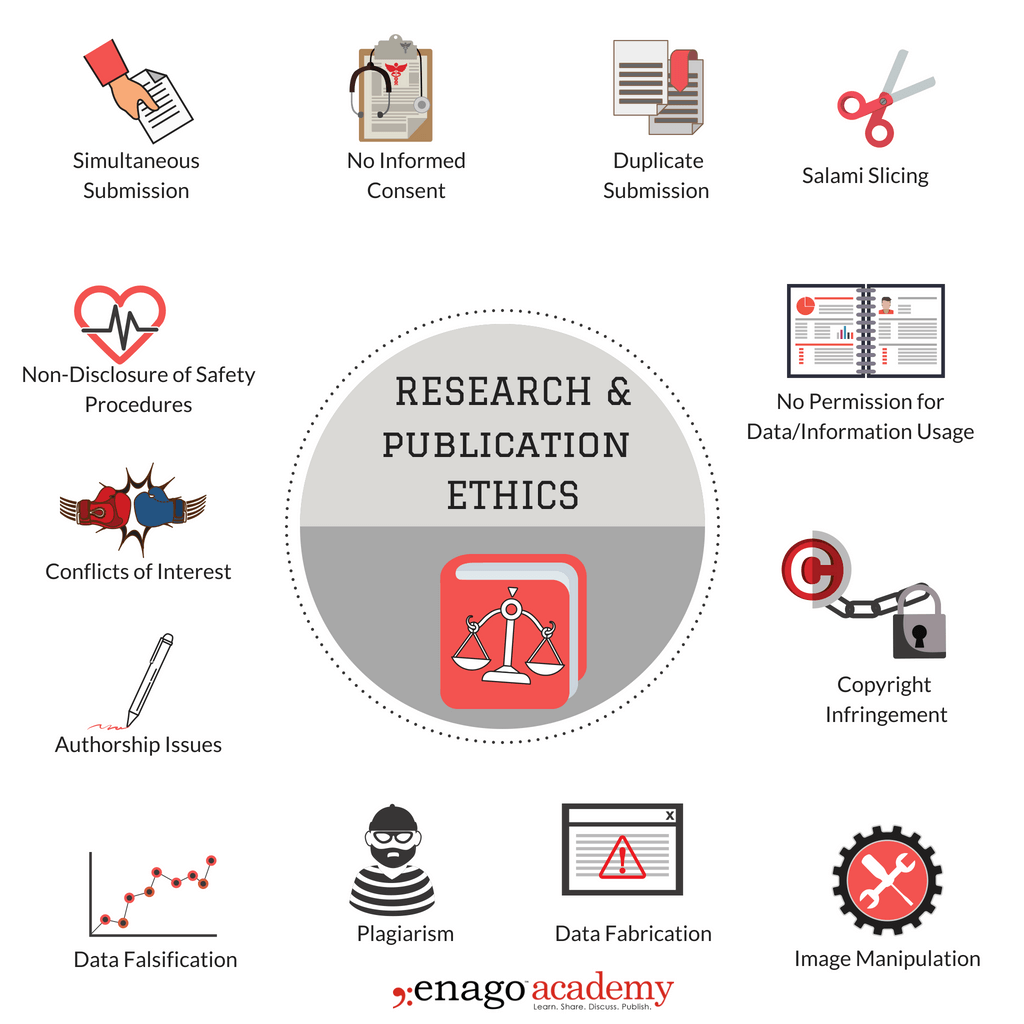
Research misconduct can have dire consequences. For instance, surgeon Paolo Macchiarini conducted experiments on patients without sound preclinical data. He worked on artificial transplantation of trachea within several patients, which turned out to be pathbreaking in medical history. However, it was all based on lies and fabricated data. Most of the patients who took part in his trial (seven of nine) died. He altered his published results to make it look as if his trachea transplant work was more successful than it really was. This was a severe consequence of the breach of research ethics.

What is the Nuremberg Code?

One of the more famous ethical guidelines followed in medical research is the Nuremberg Code. Using the Nuremberg Code shows a commitment to respect research participants. The terrible experiments conducted by the Nazis during the Second World War inspired the formulation of the Nuremberg Code. These experiments often resulted in severe injury or death. In addition, none of the participants were allowed to decide upon whether or not they would like to participate. Many experiments were not done with any therapeutic aim in mind. The Nuremberg Code addresses all of these things.

Making Ethical Decisions

There are some core principles that guide ethical decision making. Firstly, you must be committed to ethical principles. This means choosing an ethical behavior even if it delays your work or means not getting published quickly in a prestigious journal.

Next, you must determine the authenticity of the facts. It is important to evaluate the credibility of the information before taking any decisions regarding the research. Create a list of actions you could take and evaluate the consequences of each one. Make a final choice that seeks to minimize harm and build trust. Ethical decision making also affects how you report research data and who can be considered an author.

Ethics governs not just the treatment provided to the research participants but also to the researchers. Any researcher who contributes substantially to a research project or paper needs to get credit. This holds true even if the researcher is a student. This is usually done by naming him/her as an author on the final paper. It is best to have this discussion before writing the research paper. That way, everyone involved can have their say. A person should not be included as an author because of his/her position in the institute. For example, the head of a department should only be included as one of the authors of the paper, if he/she did substantial work for the paper.

Researchers need to ensure that they do not wield undue influence over others. A professor may want to recruit his or her students for a study. In this case, he or she must make it clear that participation is voluntary, not compulsory. Moreover, no student must feel pressured to participate.
Research Participants Must Be Aware

Informed consent is a key principle of research ethics. It is important that the person who is invited to be part of the research understands both the benefits and the risks involved. They must have all the information that could affect their decision to participate. Each potential research participant should know:

  • Why the study is being done, how long it will last, and what methods will be used
  • Whether they have the right to not participate or to leave the study at any time
  • What are the possible risks or benefits involved, if any
  • What are the limits of confidentiality (circumstances under which their identity might be revealed)
  • Whom they can contact for their queries.

Different Research Ethics for Different Disciplines

There are general codes of ethics for different disciplines. You can use the Declaration of Helsinki for biomedical research. There are even ethics research guidelines for internet researchers and psychologists.

Regardless of the discipline, all ethical research guidelines seek to maximize good and minimize ill effects. Research ethics, therefore, require that all participants provide voluntary informed consent. All research must seek to answer questions that will benefit humanity. The risks must be minimized as far as humanly possible.

Is there anything in this checklist that could help you refine your use of ethics? Can you suggest some more rules for research ethics that need to be followed? Share your thoughts with us in the comments below!

1 Comment
  1. James says

    I always get new experiences in improving the quality of my publications

Rate this article

Rating*

Your email address will not be published.

You might also like
X

Sign-up to read more

Subscribe for free to get unrestricted access to all our resources on research writing and academic publishing including:

  • 2000+ blog articles
  • 50+ Webinars
  • 10+ Expert podcasts
  • 50+ Infographics
  • Q&A Forum
  • 10+ eBooks
  • 10+ Checklists
  • Research Guides

Warning: file_put_contents(/var/www/public/www.enago.com/academy/wp-content/cache/asset-cleanup/_storage/item/wpacu_js_optimize_bd977dd9a71dd77451a67c4f35c64366.txt): Failed to open stream: Permission denied in /var/www/public/www.enago.com/academy/wp-content/plugins/wp-asset-clean-up/classes/FileSystem.php on line 107

Warning: file_put_contents(/var/www/public/www.enago.com/academy/wp-content/cache/asset-cleanup/_storage/item/wpacu_js_optimize_36031695abd73126baae102acdb52fa8.txt): Failed to open stream: Permission denied in /var/www/public/www.enago.com/academy/wp-content/plugins/wp-asset-clean-up/classes/FileSystem.php on line 107

Warning: file_put_contents(/var/www/public/www.enago.com/academy/wp-content/cache/asset-cleanup/_storage/item/wpacu_js_optimize_1c7cd8a5c1546ef9df2c7da80ea7073c.txt): Failed to open stream: Permission denied in /var/www/public/www.enago.com/academy/wp-content/plugins/wp-asset-clean-up/classes/FileSystem.php on line 107

Warning: file_put_contents(/var/www/public/www.enago.com/academy/wp-content/cache/asset-cleanup/_storage/item/wpacu_js_optimize_4ab4ead0165e8cdba9f6d77baf223655.txt): Failed to open stream: Permission denied in /var/www/public/www.enago.com/academy/wp-content/plugins/wp-asset-clean-up/classes/FileSystem.php on line 107

Warning: file_put_contents(/var/www/public/www.enago.com/academy/wp-content/cache/asset-cleanup/_storage/item/wpacu_css_optimize_488c2a6aacbe4caa63108db240709b51.txt): Failed to open stream: Permission denied in /var/www/public/www.enago.com/academy/wp-content/plugins/wp-asset-clean-up/classes/FileSystem.php on line 107

Warning: file_put_contents(/var/www/public/www.enago.com/academy/wp-content/cache/asset-cleanup/_storage/item/wpacu_css_optimize_19ed99e13f5698bb468563eb966f2c48.txt): Failed to open stream: Permission denied in /var/www/public/www.enago.com/academy/wp-content/plugins/wp-asset-clean-up/classes/FileSystem.php on line 107
Click to listen highlighted text!
Researchers' Poll

What should be the top priority while integrating AI into the peer review process?