


Warning: Undefined array key "HTTP_CLOUDFRONT_FORWARDED_PROTO" in /var/www/public/www.enago.com/academy/wp-config.php on line 10

Notice: Function _load_textdomain_just_in_time was called incorrectly. Translation loading for the accelerated-mobile-pages domain was triggered too early. This is usually an indicator for some code in the plugin or theme running too early. Translations should be loaded at the init action or later. Please see Debugging in WordPress for more information. (This message was added in version 6.7.0.) in /var/www/public/www.enago.com/academy/wp-includes/functions.php on line 6121

Notice: Function _load_textdomain_just_in_time was called incorrectly. Translation loading for the cite domain was triggered too early. This is usually an indicator for some code in the plugin or theme running too early. Translations should be loaded at the init action or later. Please see Debugging in WordPress for more information. (This message was added in version 6.7.0.) in /var/www/public/www.enago.com/academy/wp-includes/functions.php on line 6121

Notice: Function _load_textdomain_just_in_time was called incorrectly. Translation loading for the favorites domain was triggered too early. This is usually an indicator for some code in the plugin or theme running too early. Translations should be loaded at the init action or later. Please see Debugging in WordPress for more information. (This message was added in version 6.7.0.) in /var/www/public/www.enago.com/academy/wp-includes/functions.php on line 6121

Notice: Function _load_textdomain_just_in_time was called incorrectly. Translation loading for the miniorange-login-openid domain was triggered too early. This is usually an indicator for some code in the plugin or theme running too early. Translations should be loaded at the init action or later. Please see Debugging in WordPress for more information. (This message was added in version 6.7.0.) in /var/www/public/www.enago.com/academy/wp-includes/functions.php on line 6121

Deprecated: TotalPollVendors\TotalCore\Foundation\Environment implements the Serializable interface, which is deprecated. Implement __serialize() and __unserialize() instead (or in addition, if support for old PHP versions is necessary) in /var/www/public/www.enago.com/academy/wp-content/plugins/totalpoll/vendor/misqtech/totalsuite-totalcore/src/Foundation/Environment.php on line 14

Notice: Function _load_textdomain_just_in_time was called incorrectly. Translation loading for the user-profile domain was triggered too early. This is usually an indicator for some code in the plugin or theme running too early. Translations should be loaded at the init action or later. Please see Debugging in WordPress for more information. (This message was added in version 6.7.0.) in /var/www/public/www.enago.com/academy/wp-includes/functions.php on line 6121

Notice: Function _load_textdomain_just_in_time was called incorrectly. Translation loading for the wp-latest-posts domain was triggered too early. This is usually an indicator for some code in the plugin or theme running too early. Translations should be loaded at the init action or later. Please see Debugging in WordPress for more information. (This message was added in version 6.7.0.) in /var/www/public/www.enago.com/academy/wp-includes/functions.php on line 6121

Notice: Function _load_textdomain_just_in_time was called incorrectly. Translation loading for the anspress-question-answer domain was triggered too early. This is usually an indicator for some code in the plugin or theme running too early. Translations should be loaded at the init action or later. Please see Debugging in WordPress for more information. (This message was added in version 6.7.0.) in /var/www/public/www.enago.com/academy/wp-includes/functions.php on line 6121

Notice: Function _load_textdomain_just_in_time was called incorrectly. Translation loading for the publisher domain was triggered too early. This is usually an indicator for some code in the plugin or theme running too early. Translations should be loaded at the init action or later. Please see Debugging in WordPress for more information. (This message was added in version 6.7.0.) in /var/www/public/www.enago.com/academy/wp-includes/functions.php on line 6121
Research Integrity: Focus on research misconduct – Enago
Welcome to Enago Academy   Click to listen highlighted text! Welcome to Enago Academy

Research Misconduct: Things you need to know!

Avoiding ethical breaches is crucial in publishing to bolster academic and research integrity. While adherence to the ethical guidelines in research and publishing fosters trust within the academic community, several times, stakeholders breach them unintentionally. Although journal policies and bodies like Committee on Publication Ethics (COPE) provide guidelines for publication ethics, understanding the preliminary concepts in research misconduct can help in comprehending them better.

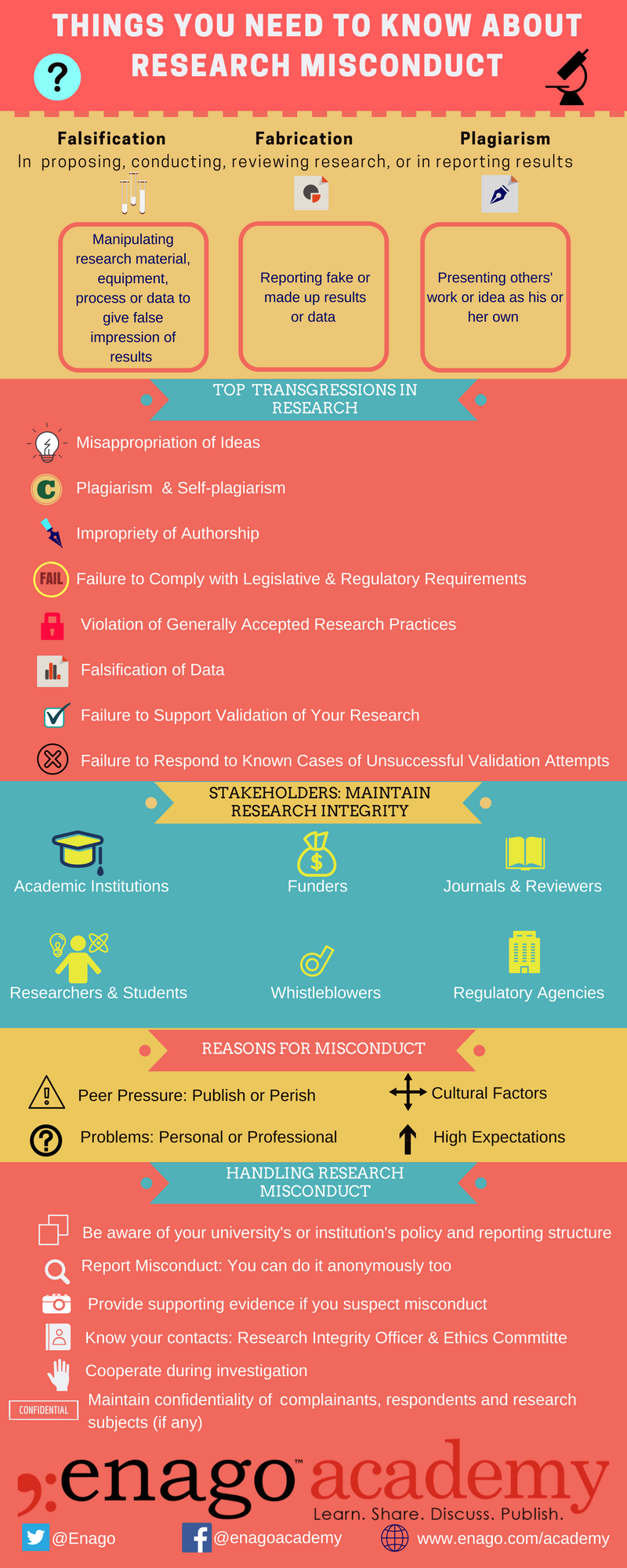
Research misconduct refers to unethical behavior in proposing, conducting, reviewing, or reporting research. The three key forms of misconduct include:

  1. Falsification: This involves manipulating research materials, equipment, processes, or data to create a false impression of the results.
  2. Fabrication: This includes reporting fake or made-up results or data.
  3. Plagiarism: This occurs when someone presents others’ work or ideas as their own without proper acknowledgment.

Such unethical practices in research can severely compromise the quality, reliability, and credibility of scientific findings. Listed below are some common forms of research misconduct.

Top Transgressions in Research

Some common unethical practices in research include:

  1. Misappropriation of ideas refers to when someone uses another researcher’s ideas without proper permission or acknowledgment.
  2. Self-plagiarism entails reusing one’s own previously published work without appropriate disclosure.
  3. Impropriety of authorship includes unethical practices such as excluding rightful contributors or granting authorship to individuals who have not made substantial contributions.
  4. Researchers must comply with legislative and regulatory requirements, failure to do so constitutes misconduct.
  5. Violation of widely accepted standards and protocols undermines research integrity.
  6. Falsification of data constitutes altering, misrepresenting, or manipulating data to fit a desired narrative which is a serious ethical breach.
  7. Researchers have a responsibility to provide sufficient evidence and data to validate their findings, failing to do so constitutes research misconduct.
  8. Ignoring or failing to address issues arising from unsuccessful attempts to replicate or validate research results is also considered misconduct.

Ensuring research integrity is a shared responsibility that involves a variety of stakeholders.

Stakeholders That Maintain Research Integrity

Research integrity is a collective responsibility. Key stakeholders include academic institutions, universities, research centers, funders, journals, peer reviewers, regulatory agencies, etc. Furthermore, researchers and students must abide by ethical guidelines.

For the stakeholders to uphold research integrity, it is crucial to understand the causes of research misconduct which can help in developing strategies to mitigate it.

Reasons for Misconduct

Researchers usually succumb to misconduct due to the immense pressure to publish or to secure funding. Another notable reason is to achieve career advancement in a highly competitive environment. Unrealistic expectations, tight deadlines, and a lack of support can lead individuals to prioritize results over ethical practices. Furthermore, systemic issues like inadequate training in research ethics, insufficient oversight, or a culture that values quantity of publications over quality could also result in such behavior.

When faced with a case of research misconduct, it is essential to follow a structured approach to ensure a fair and thorough resolution.

Handling Research Misconduct

The steps below will help you navigate a case of research misconduct smoothly:

  1. Familiarize yourself with your institution’s policies and reporting structures for research misconduct.
  2. Report misconduct with supporting evidence. Anonymous reporting options may also be available.
  3. Identify and reach out to the appropriate contacts, such as the Research Integrity Officer or Ethics Committee.
  4. Cooperate fully during the investigation process.
  5. Maintain confidentiality to protect complainants, respondents, and research subjects involved in the matter.

Aimed to uphold research integrity, we help you in understanding the different aspects of research misconduct and ways to handle it in this infographic!
Research Misconduct

Rate this article

Rating*

Your email address will not be published.

You might also like
X

Sign-up to read more

Subscribe for free to get unrestricted access to all our resources on research writing and academic publishing including:

  • 2000+ blog articles
  • 50+ Webinars
  • 10+ Expert podcasts
  • 50+ Infographics
  • Q&A Forum
  • 10+ eBooks
  • 10+ Checklists
  • Research Guides

Warning: file_put_contents(/var/www/public/www.enago.com/academy/wp-content/cache/asset-cleanup/_storage/item/wpacu_js_optimize_bd977dd9a71dd77451a67c4f35c64366.txt): Failed to open stream: Permission denied in /var/www/public/www.enago.com/academy/wp-content/plugins/wp-asset-clean-up/classes/FileSystem.php on line 107

Warning: file_put_contents(/var/www/public/www.enago.com/academy/wp-content/cache/asset-cleanup/_storage/item/wpacu_js_optimize_36031695abd73126baae102acdb52fa8.txt): Failed to open stream: Permission denied in /var/www/public/www.enago.com/academy/wp-content/plugins/wp-asset-clean-up/classes/FileSystem.php on line 107

Warning: file_put_contents(/var/www/public/www.enago.com/academy/wp-content/cache/asset-cleanup/_storage/item/wpacu_js_optimize_1c7cd8a5c1546ef9df2c7da80ea7073c.txt): Failed to open stream: Permission denied in /var/www/public/www.enago.com/academy/wp-content/plugins/wp-asset-clean-up/classes/FileSystem.php on line 107

Warning: file_put_contents(/var/www/public/www.enago.com/academy/wp-content/cache/asset-cleanup/_storage/item/wpacu_js_optimize_4ab4ead0165e8cdba9f6d77baf223655.txt): Failed to open stream: Permission denied in /var/www/public/www.enago.com/academy/wp-content/plugins/wp-asset-clean-up/classes/FileSystem.php on line 107

Warning: file_put_contents(/var/www/public/www.enago.com/academy/wp-content/cache/asset-cleanup/_storage/item/wpacu_css_optimize_488c2a6aacbe4caa63108db240709b51.txt): Failed to open stream: Permission denied in /var/www/public/www.enago.com/academy/wp-content/plugins/wp-asset-clean-up/classes/FileSystem.php on line 107

Warning: file_put_contents(/var/www/public/www.enago.com/academy/wp-content/cache/asset-cleanup/_storage/item/wpacu_css_optimize_19ed99e13f5698bb468563eb966f2c48.txt): Failed to open stream: Permission denied in /var/www/public/www.enago.com/academy/wp-content/plugins/wp-asset-clean-up/classes/FileSystem.php on line 107
Click to listen highlighted text!
Researchers' Poll

What should be the top priority while integrating AI into the peer review process?